

 Français
 Deutsch
 Italiano
 Русский
 Español
 Português
 Nederlandse
 Ελληνικά
 日本語
 한국
 العربية
 हिन्दी
 Türkçe
 Indonesia
 Tiếng Việt
 ไทย
 বাংলা
 فارسی
 Polski

180°C crystalline Low melting point Fiber, Hot Adhesive Staple for Composite Fabric & Automotive Interior & Filtration
Specifications can be customized.
Traditional bonded textile and nonwoven production has long relied on liquid glues, acrylic resins and chemical binders to hold fiber webs together. While effective, these processes carry well-known drawbacks: adhesive residues can carry odor, formaldehyde and VOC concerns for skin-contact and household products; over-spray and uneven coating lead to delamination, stiff hand feel and high defect rates; and chemical consumables add material cost and wastewater treatment burden to factories. Low-grade low-melt fibers, meanwhile, often suffer from wide melting point ranges, weak bond strength, poor wash resistance and uneven dispersion, resulting in unstable finished quality and frequent process adjustments.
This 180°C crystalline low-melt staple fiber solves those problems at the fiber level. Its crystalline low-melt polymer formulation is engineered to melt sharply at around 180°C: below this temperature the fiber stays solid and handles like ordinary polyester; once the thermal bonding zone reaches the target temperature, the outer polymer quickly melts, wets onto adjacent fibers and forms stable bonding points. Because the melt behavior is crystalline rather than amorphous, the bonding points recrystallize into a strong, durable structure on cooling, with better water resistance, moderate heat resistance and higher peel strength than ordinary low-melt alternatives.
The 3D regular denier and 51 mm staple length are chosen for universal process compatibility. The denier is fine enough to disperse evenly through blended webs, yet robust enough to withstand carding and needle punching without excessive breakage. The 51 mm length matches standard cotton-system and nonwoven production lines, so mills can introduce thermal bonding production without major equipment modification. When blended with regular polyester, hollow fibers, cotton or viscose at ratios from 5% to 40%, it creates controllable bond strength ranging from soft flexible wadding to stiff structural felts.
For brands and buyers, the biggest value is clean, safe finished products. Because bonding is purely thermal and physical, there is no glue, no solvent, no residual chemical binder and no associated odor. This makes the fiber well suited for bedding, baby products, hygiene materials, filtration media and any product where low VOC, skin-safe and eco-friendly attributes are important.
Every production batch is verified for melting point, melt flow, denier tolerance and staple length uniformity to ensure predictable, repeatable performance on production lines. We supply bulk stock and support customization of denier, length, melting point grade and blended functional formulas. Samples are available for thermal bonding trials, peel strength testing, wash durability evaluation and nonwoven production verification before placing bulk orders.
Air filter media, liquid filter felts, hygiene nonwovens, industrial felts and geotextiles. Even thermal bonding creates a uniform pore structure and stable web strength, suitable for filtration and industrial nonwoven products requiring consistent performance.
Thermal-bonded wadding, non-glue cotton, mattress padding, quilt batting and pillow lining layers. Adhesive-free bonding produces clean, odorless wadding with good wash durability, ideal for mid-to-high-end bedding and home textile products.
Automotive interior felts, door panel liners, trunk substrates, ceiling felts and sound insulation materials. Stable high-temperature bond strength and formaldehyde-free composition meet automotive interior quality and environmental requirements.
Shirt interlining, garment fusible interlining, composite fabric base layers and shoe material linings. Controlled melting behavior delivers precise bond strength without stiffening or strike-through, supporting clean, lightweight composite lamination.
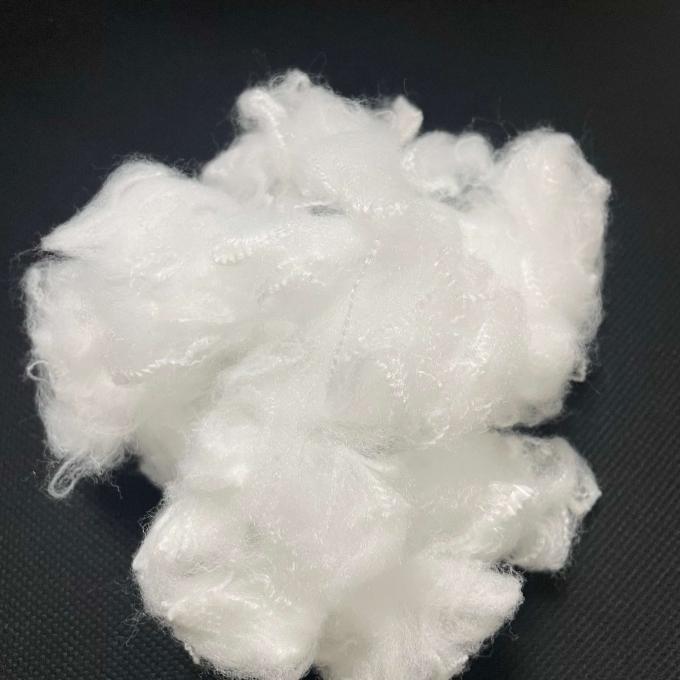
Formulated with a crystalline low-melt polymer system, the fiber melts sharply at around 180°C with a narrow and predictable temperature window. Molten polymer flows evenly onto adjacent fibers and recrystallizes into a firm bonding point upon cooling, delivering consistent, uniform bond strength across the entire web — avoiding the weak or over-melted spots common with low-grade low-melt fibers.
3D regular denier balances tensile strength, opening performance and dispersion uniformity, while the 51 mm staple length fits mainstream carding, needle punching and thermal bonding production lines. It opens, blends and cards smoothly with minimal clumping or fly waste, and distributes evenly throughout fiber webs for consistent bonding results.
Bonding is achieved entirely through heat melting and physical crystallization, with no liquid glue, resin or chemical binder required. This eliminates formaldehyde, solvent residues and adhesive odor, making finished products safer for skin contact, home textile, baby product and food-contact filtration applications, and supporting clean-label and eco-friendly product positioning.
After cooling and recrystallization, the bonding points form a tough, durable crystalline structure with better water resistance and heat endurance than amorphous low-melt bonds. Finished composites resist delamination after repeated washing and maintain bond strength under moderate heat, extending the service life of waddings, filters and laminated fabrics.
Controlled crimp and consistent denier ensure the low-melt staple disperses evenly throughout blended fiber webs, avoiding localized agglomeration or uneven bonding. This reduces weak spots, delamination and surface defects in finished nonwovens and waddings, lowering rejection rates and improving production yield.
Every batch is strictly tested for melting point, denier tolerance, staple length and melt flow behavior. Narrow melting point deviation means production line temperatures do not need frequent readjustment between batches, helping factories maintain stable process parameters and efficient high-volume output.
Suitable for thermal-bonded nonwovens, spray-bonded cotton replacement, automotive interior felts, air and liquid filter media, garment interlining, mattress pads, composite wadding and insulation materials. It can be blended at different ratios with other fibers to tune bond strength, stiffness, softness and cost.
| Item | Parameter |
|---|---|
| Product Name | 180°C Crystalline Low Melting Polyester Staple Fiber (LMF) |
| Denier | 3D (regular denier) |
| Cut Length | 51 mm (standard thermal bonding grade) |
| Melting Point | Approx. 180°C (crystalline type, narrow melting range) |
| Bonding Type | Thermal fusion / hot-melt physical bonding |
| Color | Natural raw white |
| Raw Material | Modified low-melting polyester (PET) |
| Core Advantages | 180°C precision crystalline melt, adhesive-free clean bonding, wash-resistant durable bond, 3D/51 mm universal process fit, even dispersion, batch stable, eco-friendly |
| Main Application | Thermal-bonded nonwovens, wadding & padding, automotive interiors, filter materials, garment interlining, composite textiles, insulation felts |
| Compatible Process | Carding, needle punching, thermal bonding, air-laid, blending & opening |
| MOQ | Bulk order negotiable, sample available |
A: It is a modified polyester staple fiber that melts at approximately 180°C. When heated in a thermal bonding oven or calender, the low-melt polymer softens, flows onto surrounding fibers and recrystallizes upon cooling, forming firm physical bonding points. No liquid glue or chemical binder is needed — the bond is created entirely by heat fusion.
A: Crystalline LMF has a sharp, well-defined melting point and recrystallizes on cooling, forming stronger, more heat- and wash-resistant bonding points. Amorphous low-melt fibers have a wider softening range, generally form weaker bonds and are more prone to softening again under heat or after washing.
A: Blending ratio depends on the required bond strength, stiffness and hand feel. For soft thermal-bonded wadding, 10–20% addition is common; for stiffer structural felts and filter media, 20–40% is typically used. We can recommend a starting ratio based on your end product and target performance.
A: It works with carding, needle punching, through-air thermal bonding, calender bonding, air-laid and other mainstream nonwoven and wadding processes. The 3D × 51 mm specification fits most standard production lines without major process changes.
A: The crystalline bonding structure has good water resistance. Under normal washing conditions, bonded waddings and nonwovens maintain bond strength better than those made with amorphous low-melt fiber, with lower risk of delamination. Actual wash durability should be verified with your specific product structure and washing conditions.
A: No. Bonding is achieved entirely by thermal melting of the fiber itself. There is no liquid glue, resin or chemical adhesive added, so finished products are free of adhesive-related residues, odor and formaldehyde concerns.
A: Yes. We can adjust denier, staple length and melting point grade to match your production process and end product requirements, and can also supply pre-blended low-melt mixtures with other fiber types.
A: Yes, samples are available for melting point verification, thermal bonding trials, peel strength testing, wash durability evaluation and nonwoven pilot production. Please share your process parameters and target application so we can prepare the appropriate sample specification.
low melting point polyester staple fiber
,hot adhesive staple for composite fabric
,crystalline fiber for automotive interior
Ms. Heidi
Overseas Sales Manager
- Email: heidi@bzyfiber.com
- Tel: 0086-18102756185
- WhatsApp: 8618102756185
-
WeChat:
0086-18102756185
-
High-quality 0.9D Imitation Virgin Ultra-Fine Down Alternative Fill,Recycled Silky Fill for Items such as down jackets Home Textile & Soft Toys
Product Overview High-quality 0.9D recycled down-alternative fiber engineered to deliver the softness and loft of natural down without its cost, allergen, or care drawbacks. Ideal for down jackets, home textiles, and soft toys. Fiber Type 0.9D recycled down-alternative staple fiber Specification 0... -
high quality 13D White Imitation wool fiber white straight silk Fiber, Stiff Lustrous Long Pile for Artificial Fur & Plush Fabric
Product Overview 13D × 102MM | White Straight Staple Fiber High-quality 13D white imitation wool fiber — a straight, stiff, lustrous long-pile staple engineered for artificial fur and plush fabric production. Specifications can be fully customized to meet your requirements. Detailed Product ... -
High quality black polyester staple fiber,Uniform Fade-Resistant Fine Fiber , Suitable for yarn spinning, nonwovens and automotive interiors
Product Overview Product: High-Quality Dope-Dyed Black Polyester Staple Fiber Specification: 2.5D * 51mm Customization: Specifications can be tailored to your requirements. This 2.5D * 51mm dope-dyed black polyester staple fiber is engineered to solve long-standing challenges in fine black fiber ...

